Public media guide
Lossless vs Lossy Media Compression: Mathematical Principles and Information Theory
An information theory exploration of data compression: Shannon entropy limits, Discrete Cosine Transform (DCT), run-length encoding, Huffman coding, and multi-generation transcode loss.
All digital media compression is fundamentally an exercise in applied information theory. Whether compressing a 4K video stream, a raw audio studio master, or an uncompressed bitmap, the engineering objective is to represent information using the minimum number of binary digits.
In 1948, Claude Shannon established the mathematical foundations of communication with his Source Coding Theorem, demonstrating that an absolute limit exists—Shannon Entropy—below which data cannot be losslessly compressed without information loss.
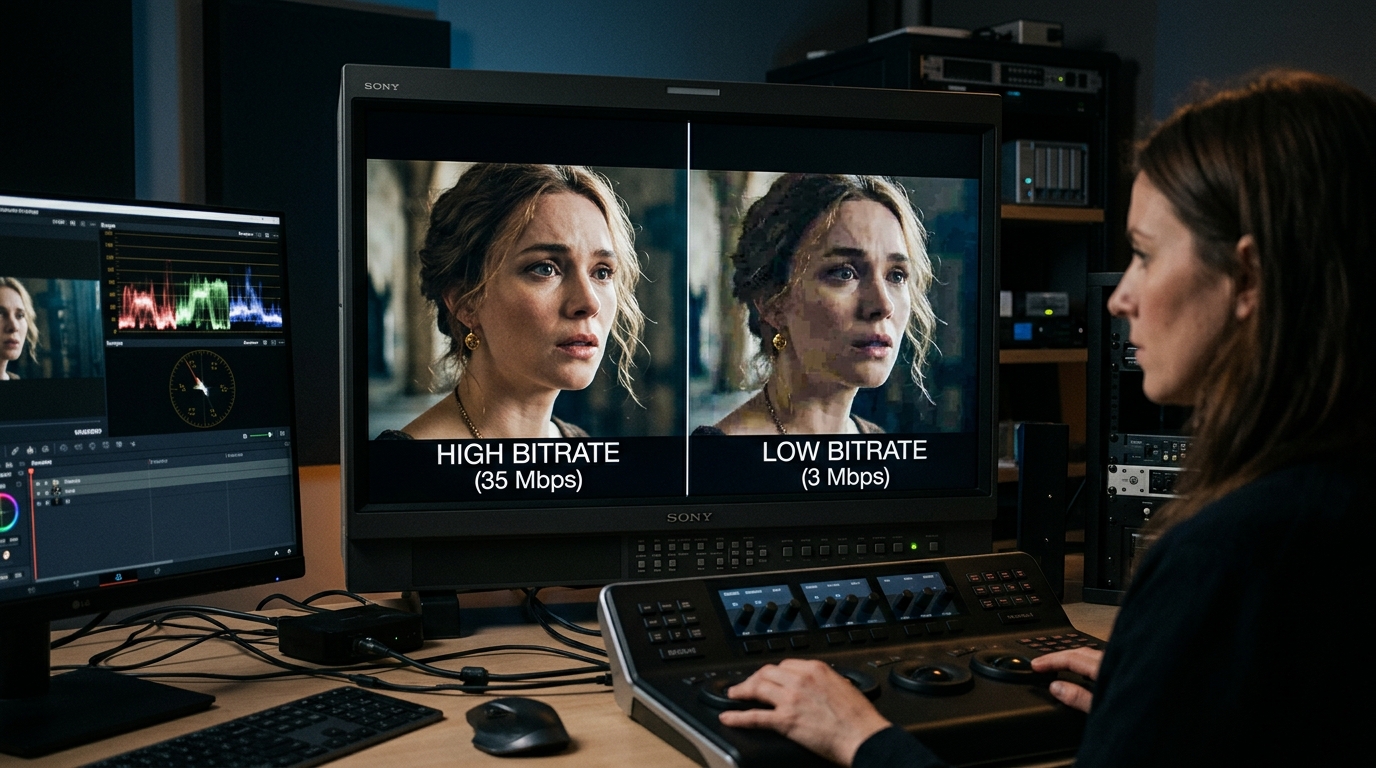
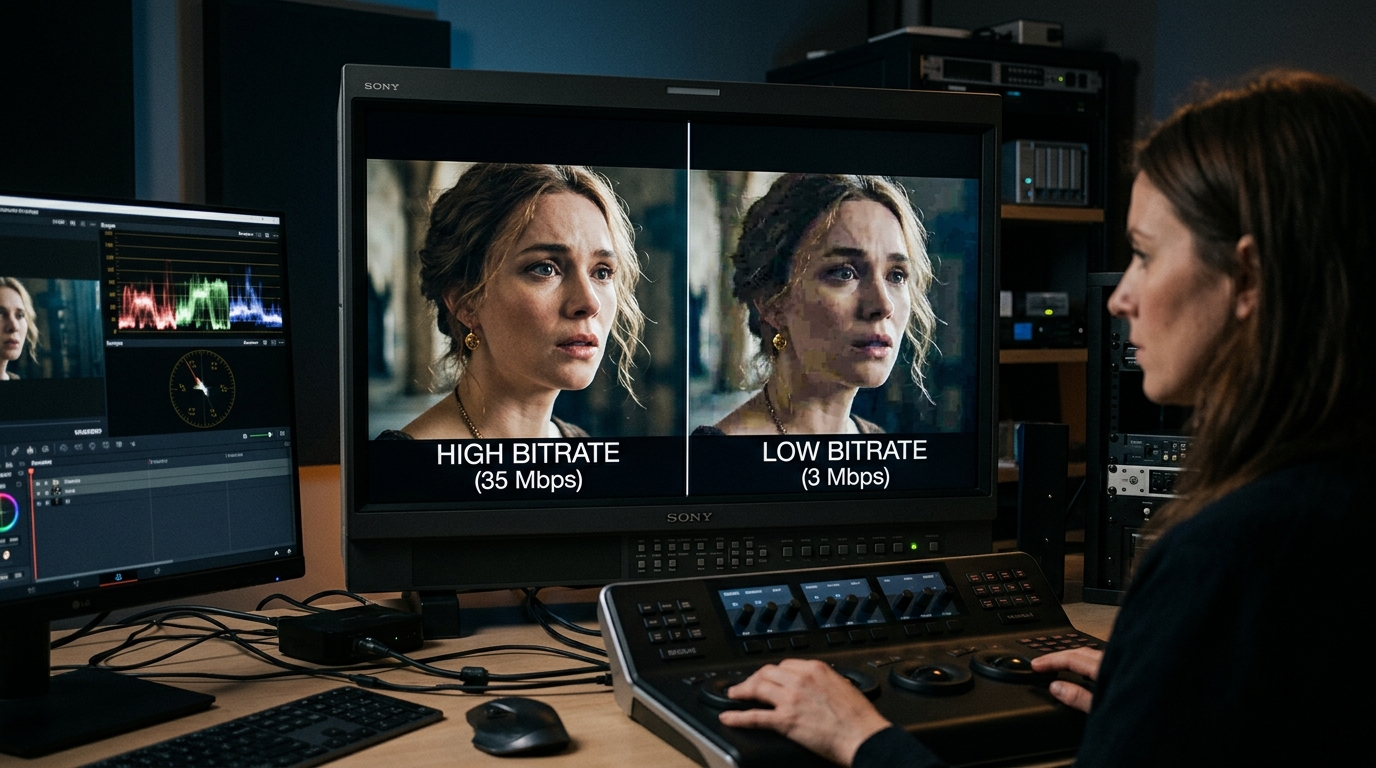
To transcend this boundary and stream high-resolution video over constrained telecommunication links, digital video engineers rely on lossy compression: intentionally discarding information that human sensory organs cannot perceive.
This technical guide explores the mathematical principles underlying entropy coding, frequency domain transforms, and the cumulative impact of multi-generational transcode degradation.
1. Shannon Entropy and Lossless Limits
In information theory, entropy H(X) measures the average amount of information produced by a stochastic data source. If certain byte symbols occur more frequently than others, the message contains statistical redundancy that can be exploited by entropy coders like Huffman Coding or Arithmetic / Range Coding.
- Variable-Length Coding: Assigns short bit sequences to frequently occurring patterns and longer bit sequences to rare patterns.
- The Incompressibility Barrier: Truly random noise has maximal entropy and cannot be compressed losslessly by any algorithm.
- Lossless Video Realities: Because raw uncompressed video rasters contain extensive visual entropy, purely lossless codecs (like FFV1 or H.264 Lossless) can only achieve roughly 2:1 to 3:1 compression ratios.
2. Spatial Energy Compaction via Discrete Cosine Transform
To achieve 50:1 or 100:1 compression ratios required for internet streaming, encoders transform spatial pixel blocks into the frequency domain using the Discrete Cosine Transform (DCT).
- Energy Compaction: Most energy in natural photographic scenes is concentrated in low spatial frequencies (broad gradients and smooth surfaces).
- DC vs AC Coefficients: The top-left coefficient (DC) represents the average block luminance; the remaining 63 coefficients (AC) describe progressively finer diagonal, horizontal, and vertical details.
- Quantization: The irreversible lossy step. High-frequency AC coefficients are divided by large quantization matrix factors, rounding subtle textures to zero.
3. Multi-Generation Degradation (Generation Loss)
A critical law of digital media production is that lossy compression is not idempotent: encoding a lossy file again compounds distortion.
- Quantization Mismatch: Even if you encode with identical bitrates, shifting macroblock boundaries or differing DCT implementations recalculate error matrices.
- The Transcode Penalty: Repeatedly uploading and downloading media across social networks re-compresses previously quantized streams, rapidly inducing severe posterization and mosquito noise.
Format & Use Table
| Characteristic | Lossless Compression | Lossy Compression |
|---|---|---|
| Mathematical Precision | Exact bit-for-bit reconstruction | Approximation based on human perception |
| Typical Compression Ratio | 2:1 to 3:1 (Video), 1.5:1 to 2:1 (Audio) | 20:1 to 100:1 (Video), 10:1 to 15:1 (Audio) |
| Theoretical Foundation | Shannon Entropy & Huffman/Arithmetic Coding | Transform Coding (DCT/Wavelet) + Quantization |
| Generation Loss | Zero (Infinite copies remain identical) | Progressive degradation with every re-encode pass |
| Primary Codecs | FLAC, ALAC, PNG, FFV1, H.264 Lossless | H.264, HEVC, AV1, MP3, AAC, Opus, JPEG |
| Optimal Use Case | Studio mastering, archival, medical imaging | Web streaming, broadcast distribution, mobile gaming |
Step-by-Step Workflow
Verify lossless file identity using cryptographic checksum: sha256sum original.wav decoded_flac.wav
Encode truly lossless video with FFmpeg: ffmpeg -i master.mov -c:v libx264 -qp 0 -preset veryslow lossless_archive.mp4
Quantify generational loss between encodes using PSNR: ffmpeg -i generation_2.mp4 -i original_master.mov -filter_complex psnr -f null -
Execute high-speed lossless archival compression with FFV1: ffmpeg -i master.mov -c:v ffv1 -level 3 -threads 8 archive_ffv1.mkv
Frequently Asked Questions
Does converting a 128 kbps MP3 to FLAC restore audio quality?
No. Converting an existing lossy file to a lossless format simply preserves the already-degraded audio in a larger file container. Once frequencies are discarded during lossy quantization, they cannot be mathematically recovered.
Why do streaming platforms never use lossless video?
A standard uncompressed 4K 60fps video stream requires roughly 12 Gbps of bandwidth. Even with lossless compression (3:1 ratio), it would still demand 4 Gbps—far beyond consumer broadband capacity.